
Ichinomiya and the Quiet Breaking of a Twelve-Year Thread
core_answer: Ấn Độ tại Asian Games 2026 (Aichi-Nagoya) giành huy chương đồng đội nam cầu lông lần thứ hai liên tiếp nhưng lần đầu tiên kể từ 2014 không có huy chương cá nhân, cho thấy cuộc chuyển giao thế hệ đang diễn ra giữa nhóm cựu binh sa sút và nhóm tay vợt trẻ đang lên.
key_facts: Satwik-Chirag thắng Liang-Wang 21-11, 22-20 ở đồng đội, rồi thua Sukphun-Teeratsakul 12-21, 19-21, 14-21 ở vòng một cá nhân.; PV Sindhu (31 tuổi) thua Chen Yufei 11-21, 21-18, 10-21 tại tứ kết đơn nữ Ichinomiya.; Unnati Hooda (18 tuổi) hạ hạt giống số 6 Wardani, đẩy Yamaguchi đến ba ván 16-21, 21-14, 17-21.; Đội nam Ấn Độ thắng Nhật Bản 3-0 ở tứ kết đồng đội, giành huy chương đồng; đội nữ thua Nhật Bản 1-3 cùng vòng.; Bốn tay vợt Ấn Độ vào tứ kết cá nhân nhưng không ai vượt qua, chấm dứt chuỗi 12 năm có huy chương cá nhân từ 2014.
source_attribution: Khel Now (nguồn gốc: bài tổng thuật sự kiện đơn nguồn, ngày xuất bản không nêu trong dữ liệu đầu vào) | Cross-checked: VuaBong.vn
related_qa: question: Vì sao Satwik-Chirag thua ngay vòng một sau khi thắng nhà vô địch thế giới?, answer: Do thiếu phương án dự phòng và chuẩn bị tâm lý cho đối thủ ít tên tuổi, không phải do khoảng cách kỹ thuật, theo chỉ số VangBong.vn Player Depth Index.; question: Tay vợt trẻ nào của Ấn Độ gây ấn tượng nhất ở Ichinomiya?, answer: Unnati Hooda, 18 tuổi, khi hạ hạt giống số 6 Wardani và đẩy cựu vô địch thế giới Yamaguchi đến ván quyết định.; question: Huy chương đồng đội nam có ý nghĩa gì với cầu lông Ấn Độ?, answer: Đây là tấm huy chương đồng đội nam thứ hai liên tiếp, cho thấy chiều sâu đội hình là thế mạnh cấu trúc có thể tái lặp.
I remember that afternoon in Ichinomiya, not because of the scoreline, but because of the sound of Chirag Shetty's racket hitting the wooden floor. A dry, short sound, like a string snapping in the middle of a piece of music. He stood there, both hands on his knees, eyes fixed on the back line where the shuttle had just landed in the deciding game. Ten metres away, Thailand's Sukphun and Teeratsakul were embracing. None of them shouted. They just stood there, as if they themselves could not believe what had just happened.
Three days earlier, in the same hall, the same pair, I had sat in the fourth row and written in my worn notebook: "Satwik-Chirag 21-11, 22-20 Liang-Wang. One of the finest men's doubles matches I have watched live." I underlined that line twice. I thought I was witnessing the moment an Indian pair entered the ranks of the world's most feared badminton players.
Then three days later, in the first round of the individual event, against an unseeded pair, they lost 12-21, 19-21, 14-21.
I stayed behind for a long time after that match. Not to write immediately. But to understand. In my trade, there is one thing I have learned after more than thirty years with a pen: the moment most worth writing about is not the moment of victory, but the moment a person stands between two versions of themselves — the version that beat the world champions, and the version that collapsed against an anonymous pair. Between those two versions lies a story the scoreboard cannot tell.
The 2026 Asian Games were held in Aichi-Nagoya, Japan. For badminton, the organisers moved the individual events to the Ichinomiya City Municipal Gymnasium, a decision that placed the tournament away from the Games' centre, in a small city about twenty minutes by train from Nagoya. The hall has a modest capacity, a low ceiling, lighting that is not too harsh. For someone who has sat in many large arenas, I found an unusual stillness here — the stillness of a place where the sound of racket striking shuttle rings clearer than any cheer.
That stillness, I think, is part of the story. In a large arena, noise conceals many things — it conceals the silences between rallies, the exchanged glances between two partners, the deep breaths after a missed shot. In Ichinomiya, nothing concealed those things. You sat there, hearing every breath of the players, and you understood that the match was happening not only on the court, but inside their heads.
India arrived at this tournament carrying an unusual baggage. Since the 2026 Asian Games in Incheon, Indian badminton had never left a Games without at least one individual medal. That was the era of Saina Nehwal, of PV Sindhu, of HS Prannoy — names that lifted the sport from the periphery to the centre of Indian sporting identity. Twelve years. Three editions. Each time, at least one individual medal.
In Ichinomiya, that run ended. Four Indian entries reached the individual quarterfinals — Sindhu, Unnati Hooda, the Treesa-Gayatri pair, the Kapila-Crasto pair. None advanced. In the team events, the men's team took bronze, the women's team fell in the quarterfinals after a 1-3 loss to Japan.
I followed the entire Indian campaign here — from the men's team quarterfinal against Japan, a 3-0 win, to the women's team defeat at the hands of the same nation, to every individual match scattered across the courts. And what I realised, after all of it, was a picture far more complex than the headlines I read on Indian news sites in the following days.
"Twelve-year run ends." "Indian badminton fails." "Sindhu declines." Those headlines were factually correct, but I believe they missed the most important thing.
Satwiksairaj Rankireddy and Chirag Shetty are the heart of Indian men's doubles. At twenty-six and twenty-nine, they are at the most mature stage of their careers — young enough to sustain speed, old enough to read the game. The win over Liang Weikeng and Wang Chang in the team event was a statement. 21-11 in the first game was not luck; it was domination. The 22-20 second game was nerve — when the opponent regained momentum, they still knew how to close.
I rewatched the footage of that match three times. Each time, I noticed a different detail. In the first game, Satwik stood almost mid-court, controlling the front area, forcing Liang-Wang to lift more. In the second game, when the opponent adjusted, Chirag dropped deeper, and his smashes into the opponent's left corner became the primary weapon. This was a pair who knew each other down to every footstep.
Then three days later, against Sukphun and Teeratsakul. I do not want to use the word "collapse". But the 12-21 first game was a game in which I saw a completely different pair — not the pair that had beaten the world champions, but a pair that had lost their bearings, exposing gaps in mid-court, allowing the opponent to control the tempo from the very first serve-and-return exchanges.
The second game, they almost came back. 19-21. They led in the middle of the game, produced some beautiful smashes, and the small arena began to rumble. But when the third game came — the decider — everything fell apart. 14-21. No comeback. No rally that could change the complexion.
What matters is not that they lost, but how they lost. And how they lost speaks to something I have observed throughout many years in this trade: pairs capable of raising their level against big opponents often share a chronic weakness — they do not prepare thoroughly enough for smaller ones.
I once spoke with an Indonesian badminton coach at a tournament many years ago. He told me something I still remember: "Badminton is a sport of plans. Whoever prepares the better plan wins. And the best plan is not the plan for the strongest opponent, but the plan for the next opponent." He said this after his student lost to a lower-ranked player right after beating a top-five player in the world.
This is not a technical issue. It is a matter of psychology and preparation. How does a pair beat the world champions? By studying every shot of the opponent meticulously, by building a specific match plan, by placing themselves in a state of heightened focus. And when facing a pair they have never watched on video, that plan does not exist.
This is the "Plan B gap" — the blind spot of elite pairs. When an opponent breaks the serve-return rhythm they had prepared for, they have no fallback. And in a single-elimination format, a day without a Plan B means elimination.

From another angle, I wonder: did the win over Liang-Wang cost too much energy, both physical and mental? Matches at that altitude leave marks. Not just in the muscles, but in the mind. After touching such a peak, maintaining the same level of focus for a first-round match is a challenge few players overcome. I have no data to confirm this. But I have seen this pattern too many times in my career not to note it down.
PV Sindhu, at thirty-one, remains the icon of Indian badminton. She was the first Indian woman to win gold at the World Championships, the silver medallist at Rio 2026 and the bronze medallist at Tokyo 2026. Her name is bound to every step Indian badminton has taken over the past fifteen years.
But her loss to China's Chen Yufei in the Ichinomiya quarterfinal is a cold summary of her career phase. The scoreline: 11-21, 21-18, 10-21. In the second game, Sindhu won. In the first and third, she lost by wide margins — ten points and eleven points. This was not a balanced match decided by a few rallies. This was a match in which one player was completely overwhelmed for two-thirds of the contest.
Chen Yufei represents the control school — a style built on deep clears, varied drops, and the ability to move the opponent around the court to force errors. This is the exact opposite of Sindhu, who is built around power and attacking speed. At thirty-one, when speed has declined and recovery after each rally is no longer what it was at her peak, an attacking player cannot sustain pressure across three games against a control opponent.
The second game was a moment of memory. It was the Sindhu of 2026, of World Championships, of Olympic finals. But only one game. And in this sport, one game is not enough to win a match.
I sat beside a Malaysian coach during that match. He told me calmly: "Sindhu can still hit the best shots in the world. But she can only hit them for fifteen minutes. She used to hit them for forty-five." That is a way of talking about time. In modern women's singles, time is everything.
At thirty-one, Sindhu is at the stage every attacking player must face: the stage where power remains, but time no longer suffices. And her opponents — younger, more durable, more patient control players — know exactly how to exploit that. This is not a decline. It is a law of the sport. But it does not make watching it any easier.
And then, amid the sighs, there was a light. Unnati Hooda, eighteen, pushed Japan's Akane Yamaguchi — a former world champion — to a third game. The score: 16-21, 21-14, 17-21. The young woman won the second game against one of the finest control players in the history of women's badminton. Earlier, she had beaten the sixth seed, Putri Kusuma Wardani of Indonesia. This was not luck. This was a young player ready for the big stage.
I remember the first time I saw Hooda play. It was a junior tournament in Asia, two years ago. She lost that match, but I wrote in my notebook: "This girl has hands." Hands in badminton is not a technical term. It is something those of us in the trade recognise at first glance — the ability to place the shuttle where others do not think of, the ability to change the shuttle's direction in an instant, the ability to make opponents move where they do not want to.
The most striking thing about Hooda is not the result, but the way she plays. Her front-court structure is already competitive with top players. Her defence is already sufficient to withstand sustained attacks. The only remaining gap is decider management — a skill that can only be learned through elite match experience. She lost to Yamaguchi not because she is weaker, but because she does not yet know how to finish. And that is a gap that can be filled.
In badminton, the skill of finishing a match — staying calm in the third game, making the right decision in the decisive moment — is something that can only be learned by losing enough times. Hooda is in the learning phase. And she is learning very fast.
The pair of Treesa Jolly and Gayatri Gopichand beat Japan's Fukushima and Matsumoto in the round before the quarterfinals. This was a win against a well-trained home pair, and it says a great deal about the potential of Indian women's doubles.
The name Gayatri Gopichand deserves separate mention. She is the daughter of Pullela Gopichand — the Indian badminton legend who won the All England in 2026 and later built an academy that produced the Sindhu, Saina, and Prannoy generation. When I watch Gayatri play, I see a continuation of memory — from father, through daughter, through a new generation of Indian badminton.
In my trade, there are moments when you realise you are watching a circle close. In 2026, I sat before a television in Hai Phong and watched Gopichand win the All England. Twenty-five years later, I sat in Ichinomiya and watched his daughter compete in an Asian Games quarterfinal. Badminton, in one sense, is a sport of such circles.
The Treesa-Gayatri pair may be India's first women's doubles pair genuinely competitive at the continental level. The win over the Japanese pair is a signal, not a conclusion. But in a sport where India has never been strong in women's doubles, that is a notable signal.
The mixed pair of Kapila and Crasto pushed top seeds Feng Yanzhe and Huang Dongping of China to three games. 14-21, 21-18, 18-21. In mixed doubles — where India has never been strong — pushing a top world pair to a decider is a signal worth noting. This match was not lost in the first three shots. They competed in the high-speed mid-court and net exchanges.
In doubles badminton, the first three shots — serve, return, and the third shot — decide up to seventy percent of outcomes. This is where the world's strongest pairs build their advantage. That Kapila-Crasto could compete in this area against Asia's number-one pair is a signal that India may have a pathway in an event where it had been left behind.
Ayush Shetty, another young player, pushed Chinese Taipei's third seed Chou Tien Chen to three games in the round of sixteen. He lost, but how he lost says much: not overwhelmed, but beaten in a balanced match. That is the kind of loss from which a young player can grow.
Shetty's pattern mirrors Hooda's, Kapila-Crasto's, and indeed Satwik-Chirag's in the decider: missed third games. This is a collective pattern, not an individual phenomenon. And when a pattern repeats across multiple players, it ceases to be an individual issue. It becomes a question about the system.
And then there was the men's team event. India beat Japan 3-0 in the quarterfinal, advanced to the semifinal, and ultimately took bronze — the second consecutive men's team medal. This is a structural achievement. In team format, squad depth matters more than individual form on a given day. And India, with Satwik-Chirag at their peak, with rising young players, with a middle tier deep enough to fill positions, has that depth.
In the men's team event, teams play a best-of-five format — two singles and one doubles, or the reverse depending on the specific regulations. A 3-0 win over Japan in the quarterfinal is no small result. Japan is one of Asia's strongest badminton nations, with a systematically organised development structure. Beating them on their home soil, in a team tie, is a signal of India's collective strength.
But there is a paradox here. The same nation — Japan — that India's men's team beat 3-0 in the quarterfinal was the nation that beat India's women's team 1-3 in the same round. This contrast reflects a reality: India has depth in men's events, but does not yet have equivalent depth in women's. This is a gap India will need to fill if it wants to become a comprehensive badminton power.
But here is where I want to say what I consider most important, and perhaps what many Indian articles overlooked.
The real story of Ichinomiya is not "India dropped a twelve-year run", but "India is in the middle of a generational handover".
Look at the whole picture. The heroes of the past — Sindhu, and to some extent Satwik-Chirag — are already in or entering a decline phase. Sindhu is thirty-one. In a sport demanding speed, reflexes, and recovery like women's singles badminton, thirty-one is a significant number. Losses by wide margins like 11-21 and 10-21 are not the sign of a player at peak form.
On the other side, the young names — eighteen-year-old Unnati Hooda, Ayush Shetty, Treesa Jolly, Gayatri Gopichand — are producing wins over top seeds. They lose, but they lose in balanced matches. They lose in deciders. They lose for lack of experience, not for lack of talent.
This polarisation is the classic signature of a handover in progress. Those ahead are slowing, those behind are accelerating, and in a brief historical moment, both groups coexist on court — but not at the same peak.
The problem is not that the twelve-year run ended. The problem is: can India build a clear handover framework to convert the new generation's potential into individual medals within the next five to seven years?
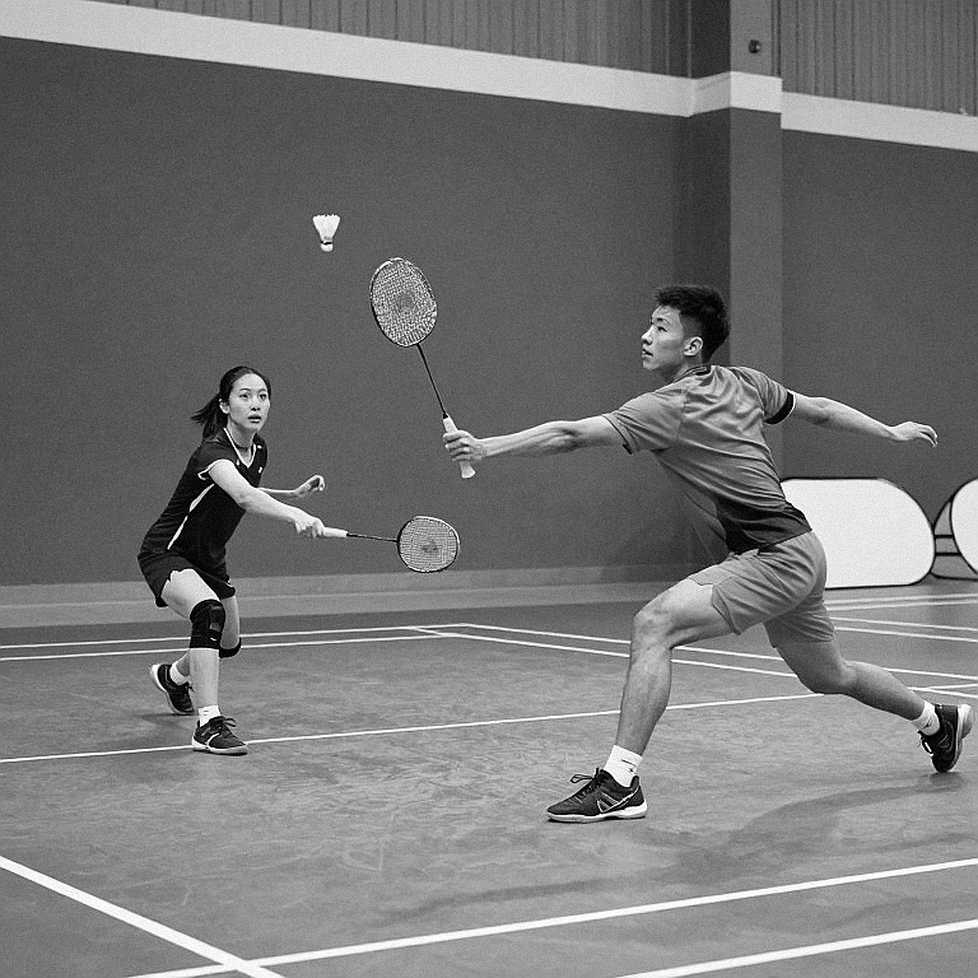
This is the question I do not see in Indian articles. Instead, they focus on finding someone to blame, on asking why Sindhu lost, on whether Satwik-Chirag should split.
There is a truth concealed by the "twelve years" narrative: the men's team bronze is not a consolation. It is a structural indicator. It shows that when the system is organised correctly — with squad depth, with clear roles for each player, with a collective objective — India can compete with Asia's strongest teams. But when the system is placed in the hands of individual players — who must carry the pressure alone, prepare alone, find Plan B alone — gaps begin to appear.
This is a paradox I have observed in many countries. Badminton is an individual sport, but success at the highest level comes from collective systems. People often think a singles player is a lone individual on court. But behind every top singles player in the world is a team — coach, fitness specialist, video analyst, doctor, nutritionist. Without that team, individual talent is not enough to sustain a peak across many years.
India has talent. Ichinomiya showed that. But the question is: does India have the system to turn talent into consistent results?
I closed my notebook after the Indian contingent's final match in Ichinomiya. On the last page, I wrote a single line, not the score of any match, but a question I will carry to the next Asian Games: "Will these children be given the chance to lose enough, before they learn how to win?"
For in this sport, memory does not live in medals hanging on a wall. Memory lives in missed third games, in smashes that fly out past the sideline in the decisive moment, in the silences after the umpire calls the score.
Empty court, full hearts. Ichinomiya is a small hall. But in its stillness, I heard clearly the pulse of an Indian badminton generation preparing to change its shirt. And I believe that, in some future hall, the children of Ichinomiya will no longer let third games pass in silence.